
Content Marketing Meets Proof Point Marketing
This post is a collaboration with Katie Helwig, President of Mild Red LLC. A fellow member of the GovCon Ideation group, Katie has developed Proof Point Marketing™, which details the intentional creation, organization, and communication of evidence that demonstrates your company’s ability to perform. It’s a new understanding of B2G marketing for an industry going through seismic change.
In this installment, Katie and I talk about how PPM intersects with content marketing. Visit Katie’s profile to see other posts in the series.
Every Proofpoint has a Mission Story
Government contractors spend enormous effort building proof. They win contracts. Deliver successful programs. Earn strong CPARS ratings. Recruit exceptional talent. Achieve cybersecurity certifications.
They develop innovative solutions that reduce risk, improve performance, and support critical missions. Yet too often, that proof is presented as a list of accomplishments rather than as evidence of mission impact.
Customers don’t simply want to know what you’ve done. They want to understand why it mattered. That’s the difference between information and storytelling. Facts establish credibility.
Stories create understanding.
Proof Point Marketing™ is about building, documenting, and communicating evidence that customers can believe.
But evidence alone isn’t enough. The organizations that stand out are the ones that help customers connect their proof to mission outcomes.
That’s where storytelling begins.
Throughout the Proof Point Marketing™ series, we’ve explored how organizations build, own, align, optimize, and amplify their proof. Each article examined a different part of the process. This article explores what happens next.
Once customers find your proof, how do you help them remember it?
The Story Is Already There
Evidence establishes credibility. But evidence alone rarely creates understanding. The same proof point can tell very different stories depending on the customer, the mission, and the outcome it supports.
A contract award may demonstrate experience. To another customer, it demonstrates familiarity with a complex acquisition environment.
A successful transition may show disciplined project management. To an operational customer, it demonstrates mission continuity and reduced implementation risk.
A recruiting metric may indicate hiring success. To a program executive, it represents workforce stability and sustained mission readiness.
A cybersecurity certification may validate compliance. To a customer responsible for protecting sensitive systems, it demonstrates organizational discipline and trustworthiness.
The proof itself never changes. What changes is the lens through which the customer views it.
Storytelling helps customers connect evidence to the mission outcomes they care about most. That transition—from evidence to understanding—is where storytelling creates value.
It also explains why organizations sometimes struggle to tell their own stories. They focus on describing what they did instead of helping customers understand why it mattered.
That’s where Christopher Parente’s perspective becomes especially valuable. As Christopher – founder of StoryTech Consulting – often reminds his clients, effective messaging doesn’t begin by asking:
“What do we want to say about ourselves?” It begins by asking:
What proof does the customer care about—and what story does that proof already tell?
Start With the Proof, Not the Aspiration
Organizations often struggle to recognize the stories they already possess because they begin in the wrong place. Leadership decides how it wants the company to be perceived. Marketing is then asked to make that message believable. The story becomes aspirational, not based on the needs of the client.
But customers don’t define a company by what leadership hopes they will believe. They define it by what they experience.
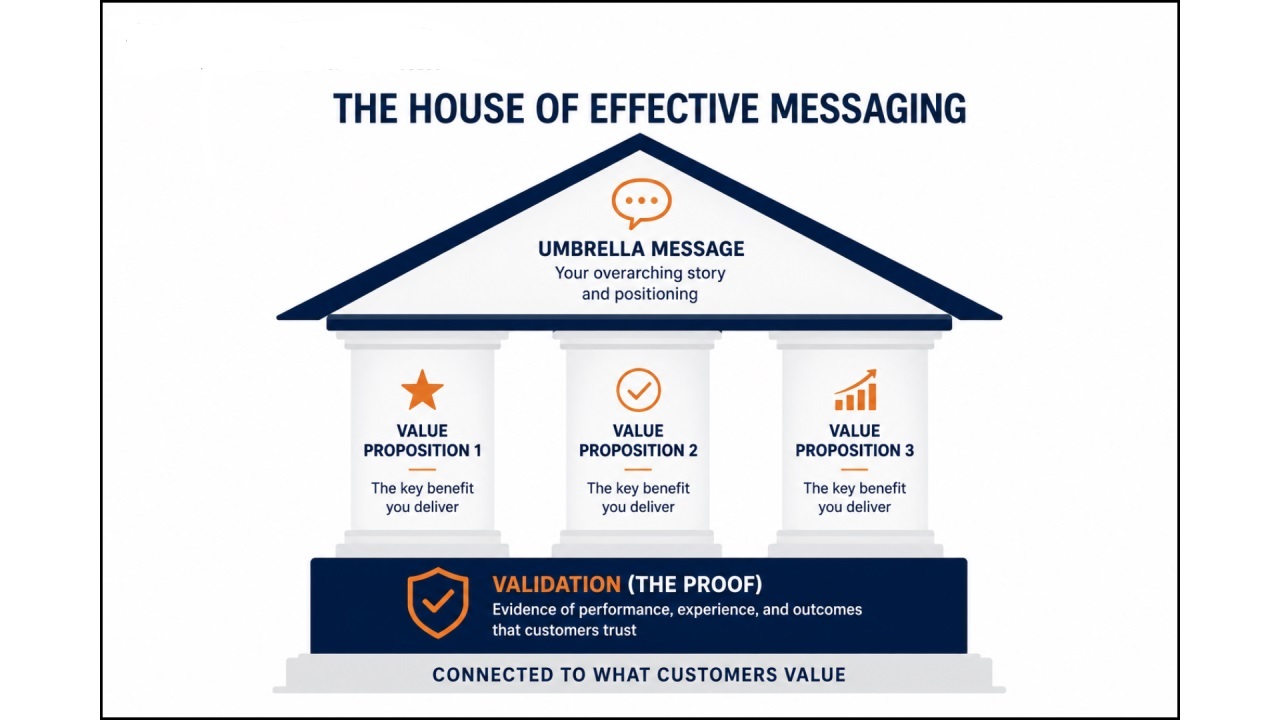
Christopher encourages clients to think about messaging as a house. The roof is the organization’s umbrella message. The supporting beams are its value propositions.
The foundation is validation—the proof. If that foundation isn’t connected to what customers value, the stories built upon it won’t resonate.
Instead of asking: What do we want the market to believe? Ask: What have we demonstrated that gives the market a reason to believe it?
Storytelling grounded in proof reinforces an identity the organization has earned. Storytelling grounded only in aspiration risks sounding like marketing.
Facts Build Credibility. Stories Create Understanding.
Government contracting is built on evidence. Evaluators expect measurable performance. Customers expect demonstrated capability. Partners expect credibility.
None of those expectations change. But facts alone rarely create lasting impressions.
Decision-makers don’t remember every contract value, certification, or performance metric they review. They remember the organizations that solved meaningful problems, reduced operational risk, improved mission readiness, or helped an agency achieve a critical objective.
Storytelling isn’t about embellishing the facts. It’s about illuminating why those facts mattered.
Christopher has spent his career helping organizations transform complex expertise into compelling thought leadership.
Story doesn’t replace the proof. It reveals its significance.
Uncover the Story by Listening
Mission stories rarely emerge from a marketing brainstorming session. They are discovered by talking to the people closest to the work—and closest to the customer.
That includes leadership. Technical subject matter experts. Front-line sales. Business development.
What are customers asking? What challenges keep appearing? Which outcomes matter most?
Christopher believes those conversations are invaluable because customers are already telling organizations what they value.
Technical experts possess many of the strongest stories within a company, but they often describe their work in technical language rather than in narrative. The marketer’s role isn’t to invent a story. It’s to understand the technology, earn credibility with the experts, and translate their knowledge into a story that customers immediately understand.
When customer insight, technical expertise, and documented proof align, storytelling becomes more than content creation. It becomes strategic communication.
The Difference Between Information and Meaning
Consider two ways of communicating the same accomplishment.
Fact: “We completed the transition 30 days ahead of schedule.”
Now tell the story.
Mission Story: “Completing the transition 30 days ahead of schedule ensured uninterrupted support for a mission-critical program, allowing the agency to maintain operations without service disruption while accelerating delivery of planned capabilities.”
The proof didn’t change. The context did. One communicates performance. The other communicates mission impact and creates an emotional bond with the customer.
That’s what decision-makers remember.
Original Thinking Still Matters
AI is an extraordinary tool for research, summarization, outlining, and drafting. But it cannot determine what is genuinely distinctive about an organization’s experience.
When companies use AI to create identity rather than provide authentic proof, the result may sound competent but fail to resonate. As more organizations default to AI-generated content, original thinking grounded in customer experience and evidence becomes even more valuable.
AI can help communicate the story. It shouldn’t be expected to discover the story. That still requires listening, judgment, customer understanding, and human insight.
Tell the Proof
Throughout this series, we’ve explored how organizations build, align, optimize, and amplify their proof.
Telling the proof is where those efforts come together. The strongest organizations don’t choose between facts and stories. They use stories to explain why their evidence matters.
Every proof point already contains a story. The opportunity isn’t to invent one. It’s to uncover the one that’s already there. Proof Point Marketing™ begins with evidence. Storytelling gives that evidence meaning.
Christopher offers one final reminder that perfectly complements the philosophy behind Proof Point Marketing™ and its link to content marketing:
The customer is telling us what they value. If we listen—and tell stories that demonstrate we understand those priorities with evidence to support them—we earn more than attention.
We earn trust. Because government buyers don’t simply evaluate capabilities. They evaluate confidence. They evaluate credibility.
The organizations that consistently earn both help customers understand not only what they’ve accomplished, but why it mattered to the mission.
The proof earns credibility. The story earns understanding. Together, they earn trust.
That’s how you Tell the Proof.