Reporting from Satellite 2026
I attended the Satellite 2026 conference this week in Washington, DC. The Canadian satellite operator Telesat is a long-time client of mine, and the conference is an annual chance to get together IRL.
Anyone not living under a rock knows that the space economy is dynamic and growing. As recently as five years ago, the market was dominated by a handful of companies (including Telesat) operating fleets of Geosynchronous orbit (GEO) satellites. That all changed when Elon Musk created Starlink, featuring hundreds of Low Earth Orbit (LEO) satellites that offer the low latency required by modern Internet applications. Just look at the war in Ukraine, where LEO satellites proved conclusively how decisive they are in modern conflicts.
Jeff Bezos is now building a LEO network – Amazon LEO, formerly Project Kuiper. Telesat is launching Lightspeed, its next-generation LEO network that will take a B2B, rather than a B2C, approach to the market. The speed at which the market is moving was a major topic of the opening session panel discussion of CEOs. That, and the fact that if your name isn’t Musk or Bezos there needs to be more access to capital.
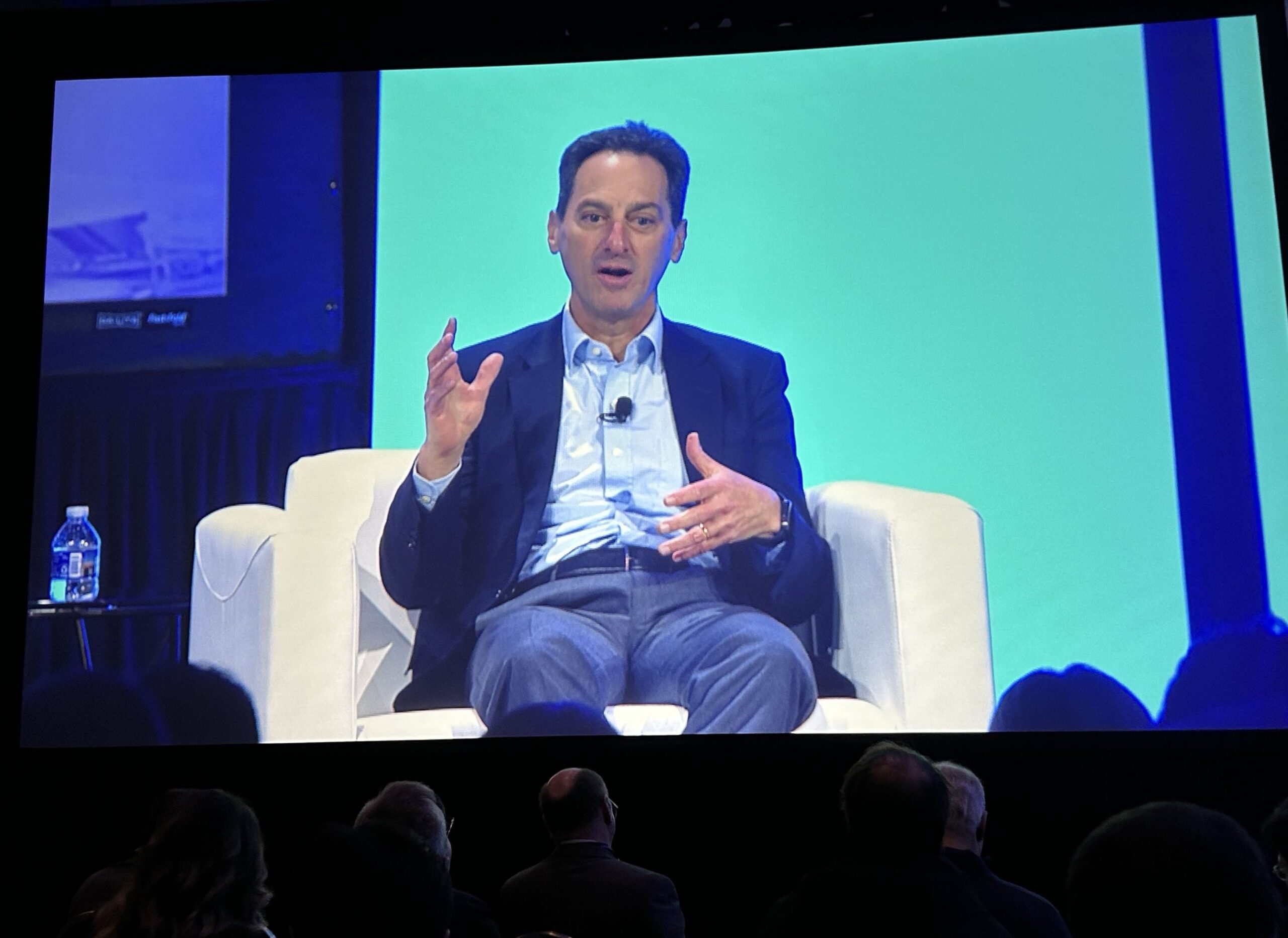
Naturally I’m biased, but I think Dan Goldberg, Telesat’s CEO, made some excellent points. One was that political tension and conflicts also have an upside. He said “the geopolitical developments we’re seeing are creating some of the biggest commercial opportunities for Telesat — and the rest of us. It’s incumbent upon us to step up.”
Telesat recently made a significant announcement regarding its Lightspeed LEO constellation, adding military Ka-band spectrum to 156 satellites. That dedicates a full quarter of Lightspeed’s capacity to defense and sovereignty programs — sovereignty being a major theme of discussion at the show. Countries want to control their own destiny for space communications, rather than depend on foreign billionaires.
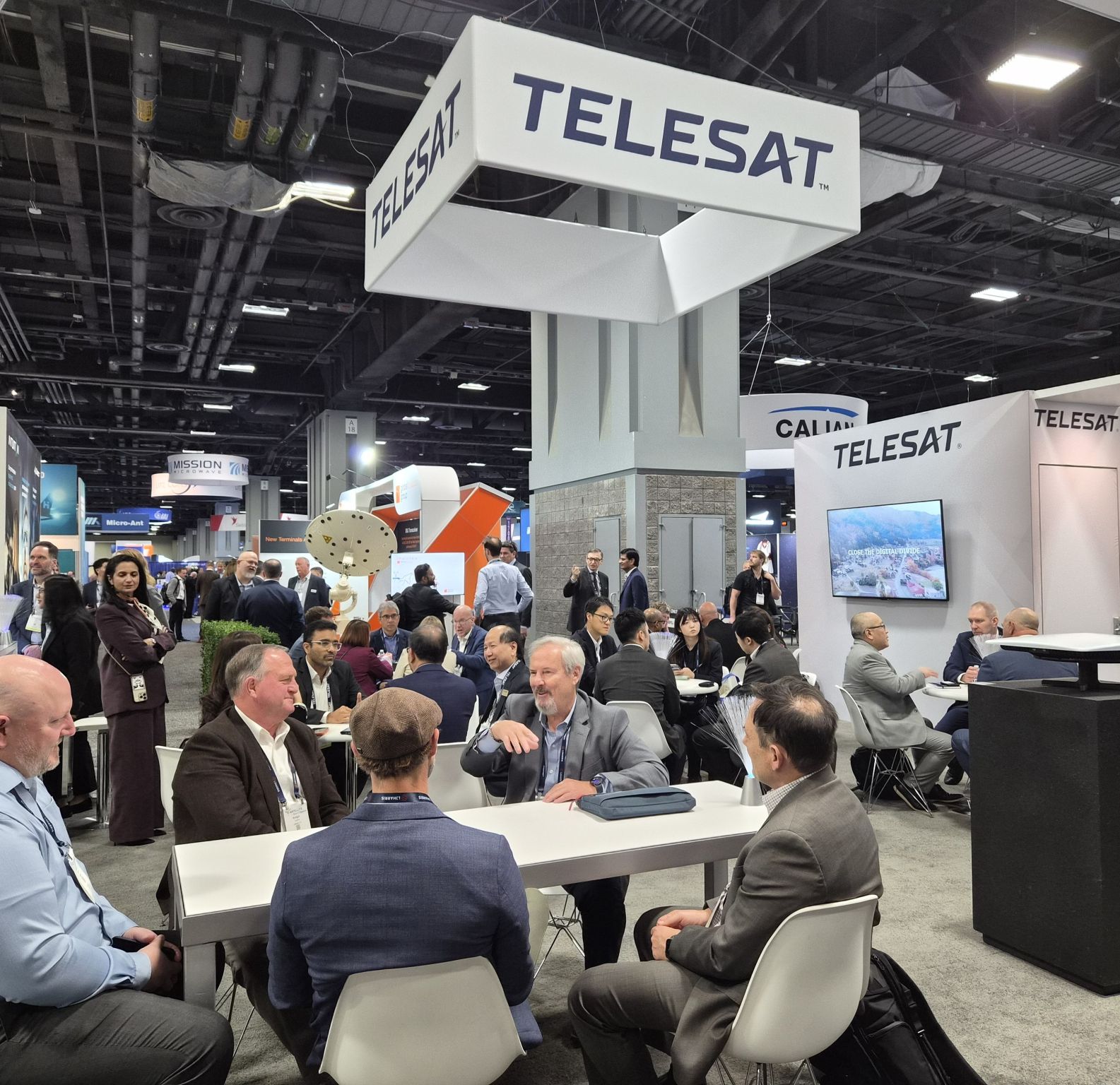
Another thing that sets Telesat apart is its go-to-market approach. Rather than go directly to end users, Telesat’s approach is to work through existing service providers and equipment manufacturers. These companies know what their customers want, and one important thing is choice. Telesat works collaboratively with all these partners to shape their service offerings, expand addressable markets, and facilitate end-user growth.
While we believe this is the right way to go, Dan was also candid about the competitive pressures Telesat faces. It does mean procuring satellites and terminals from third parties, and he acknowledged that being vertically integrated (i.e., controlling every piece of the supply chain from manufacturing to launch and ground equipment) provides advantages for Starlink and Amazon. He talked about finding a way to align interests so the non-vertically integrated players can compete. “My number one request,” he said, “is trying to find a way to align our interests so that we can all remain competitive.” He also identified space-to-space communications as an underappreciated growth opportunity as constellations multiply and interoperability becomes essential.
There was broad agreement among the panelists. Multi-orbit constellations offering both LEO and GEO are real and here to stay. The importance of sovereignty in space may work against industry consolidation that might otherwise occur. Direct-to-device has broad potential if the feature is absolutely seamless to the end user and the price is driven way down.
Viasat’s Mark Dankberg, whose company’s KA-SAT network was attacked by Russia at the onset of its invasion of Ukraine in 2022, bluntly stated that commercial satellite systems are now targets along with military ones. And two sides of the coin again: “Whenever there’s change, there’s opportunity,” he said. The threats are very real, as shown by a missile strike on an SES teleport in Israel earlier this month.
SES CEO Adel Al-Saleh described dealing with a fracturing global regulatory environment, saying this “old model” needs to change to meet the reality of space today. He’s building separate supply chains for North America and Europe and pushing to shorten development cycles that used to run five to seven years. He also promoted a 28-satellite order from startup K2 Space for its next-gen Medium Earth Orbit (MEO) network, meoSphere. Eutelsat’s Jean-François Fallacher echoed Dan’s message with a plea for open standards and interoperability — a way for operators to cooperate rather than each go it alone.
The Canadian government has made a significant investment in Telesat Lightspeed. It wants to use the constellation to close the digital divide for millions of Canadians without reliable broadband connectivity and to preserve sovereign space capabilities for national defense.
LEO technology has injected excitement into the space market, and the competition will be fierce. It’s going to be a wild ride!